
Have you ever stopped to think about what you’re made of? Not in a philosophical sense, but in a biological one.
Your hair, your skin, the enzymes digesting your food, the antibodies fighting off a cold, the hemoglobin carrying oxygen in your blood—they are all made of one essential thing: proteins.
But where do these proteins come from? They don’t just magically appear. Every single protein in your body is built through a precise, two-step process called Protein Synthesis. It’s the central dogma of molecular biology, and it’s the reason you are who you are.
Let’s break down this microscopic miracle.
Part 1: The Blueprint (DNA)
Think of your body as a massive construction company. You have billions of workers (cells) that all need to build things (proteins). But to build something correctly, you need a master blueprint.
In biology, that master blueprint is your DNA. DNA is housed safely inside the nucleus (the construction foreman’s office) of the cell. It contains all the instructions for every protein your body could ever need.
However, there’s a problem: the workers who actually assemble the proteins don’t work in the nucleus. They work in the main area of the cell called the cytoplasm. The master blueprint is too valuable and fragile to be taken out of the office and risk being damaged.
So, how do the instructions get from the nucleus to the construction site? This brings us to the first major step.
Part 2: Step 1 – Transcription (Making a Copy)
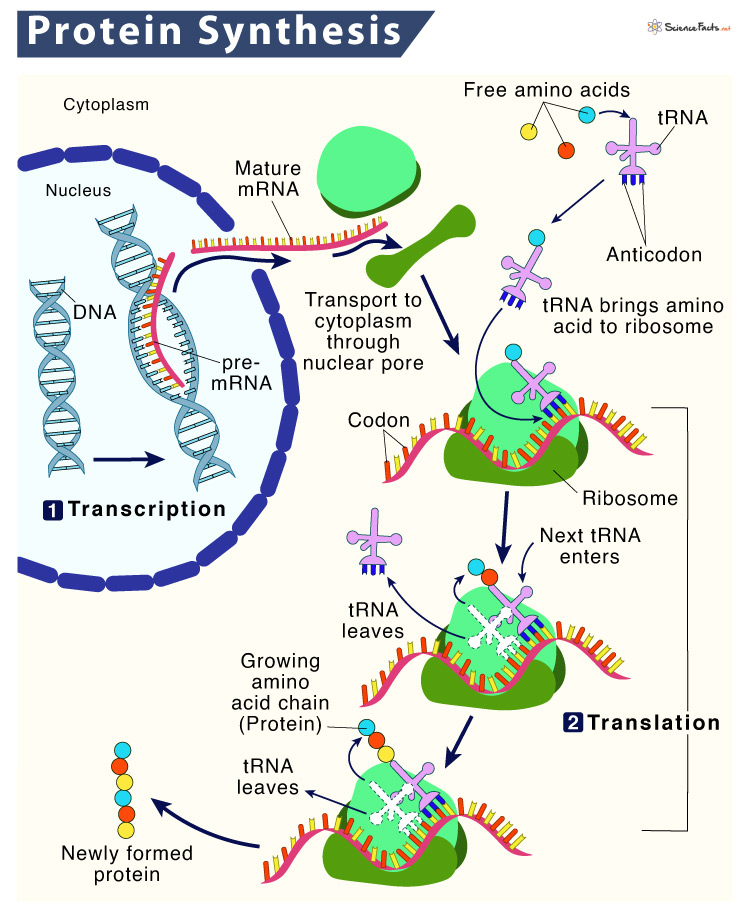
The first step is called Transcription. This is the process of creating a portable, single-stranded copy of a specific gene from your DNA. This copy is called messenger RNA (mRNA) .
Here’s how it works:
- Unzipping: An enzyme called RNA polymerase locates the specific gene needed for the protein and “unzips” that small section of the DNA double helix.
- Pairing: The RNA polymerase moves along one of the DNA strands, reading its bases (A, C, G, and T). It builds a complementary strand of mRNA. (Remember, in RNA, the base Uracil (U) replaces Thymine (T), so an A on the DNA becomes a U on the mRNA).
- Editing and Exit: Once the gene has been read, the newly formed mRNA strand is released. It goes through a quick editing process and then exits the nucleus through tiny pores, traveling into the cytoplasm to find its construction worker.
The instructions have left the blueprint room. Now, they need to be read.
Part 3: The Workers and Machinery
Before we get to the second step, we need to meet the key players in the cytoplasm:
- Ribosomes: These are the “construction workers” or, more accurately, the protein-building machines. They can be floating freely or attached to a structure called the rough ER. The ribosome’s job is to read the mRNA instructions.
- Transfer RNA (tRNA): These are the “trucks” that deliver the raw materials. They have two important ends. On one end, they carry a specific amino acid (the building blocks of proteins). On the other end, they have a three-letter “anti-codon” that matches up with a three-letter “codon” on the mRNA.
- Amino Acids: These are the individual bricks. There are 20 different types, and the specific order they are assembled in determines what the final protein will be.
Part 4: Step 2 – Translation (Building the Protein)
With the mRNA instructions delivered and the workers ready, we can begin the second step: Translation. This is where the language of nucleic acids (the mRNA code) is translated into the language of amino acids (a protein).
The process happens in three stages:
- Initiation: The mRNA strand attaches to a ribosome. The ribosome scans the mRNA until it finds the “start” signal (the codon AUG). The first tRNA molecule, carrying its specific amino acid, comes in and pairs with that start codon.
- Elongation: The ribosome then moves along the mRNA, one codon at a time. As each new codon is revealed, a tRNA with the matching anti-codon brings the correct amino acid. The ribosome helps attach this new amino acid to the growing chain, forming a peptide bond. It’s like a long, molecular assembly line.
- Termination: This chain reaction continues until the ribosome reaches a “stop” codon on the mRNA (like UAA, UAG, or UGA). This signals that the protein is complete. The finished chain of amino acids is released from the ribosome.
Part 5: The Final Fold (Making it Work)
The long chain of amino acids that results from translation is technically a protein, but it’s not ready to work yet. To become functional, it must fold into a specific, complex three-dimensional shape. This shape is absolutely critical.
Think of it like origami. A flat piece of paper (the amino acid chain) is just a piece of paper. But once you fold it according to the instructions, it becomes a crane or a flower. If you fold it wrong, it’s useless.
Sometimes, the protein needs to combine with other chains or be modified further to become active. Once it’s properly folded, it’s shipped to where it’s needed in the cell to start doing its job—whether that’s fighting infection, building tissue, or speeding up a chemical reaction.
Why This Matters
Protein synthesis happens trillions of times a day in your body. It’s a flawless, high-speed process that is the foundation of all life. When this process goes wrong—if there’s a typo in the DNA blueprint (a mutation)—it can lead to a faulty protein, which is the root cause of many diseases, from cystic fibrosis to sickle cell anemia.
So, the next time you flex a muscle, heal a cut, or digest a meal, take a moment to appreciate the incredible journey happening inside you. It’s a story of blueprints, messengers, and tiny molecular machines, all working together to build the very fabric of your existence.